
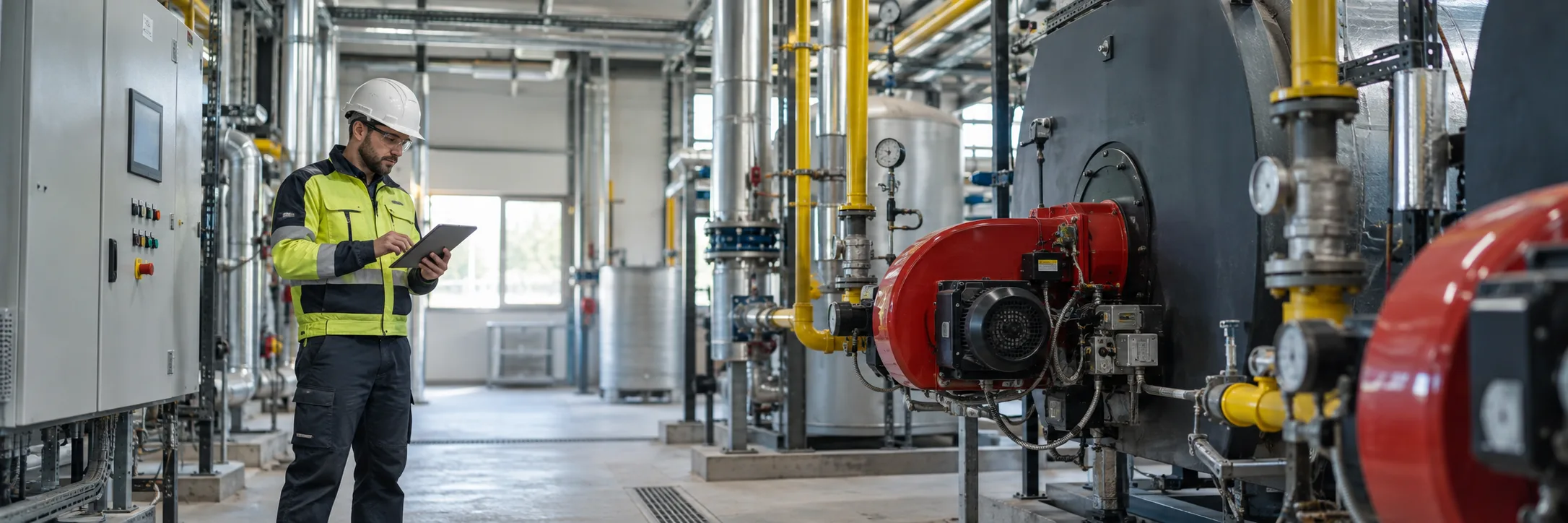
Industrial Automation for Thermal Systems: Why Integrated Control Matters
admin2026-11-20T10:47:42+02:00Industrial automation plays a central role in the performance, safety and reliability of modern thermal systems. In boiler houses, burner installations and process heating environments, automation is no longer simply about switching equipment on and off. The control system must manage combustion, instrumentation, safety interlocks, operator visibility and plant data as one connected environment. When these elements are engineered together, the plant becomes easier to operate, easier to maintain and easier to improve over time.
For industrial operators, this matters because thermal systems are often made up of equipment from different suppliers. Burners, boilers, fuel trains, control panels, field instruments, variable speed drives and monitoring systems may all come from different manufacturers. Without proper integration, each component may function correctly on its own while the overall plant remains difficult to control or troubleshoot. Industrial automation provides the layer that connects these systems and allows them to operate as one coordinated process.
What Is Industrial Automation in a Thermal Plant?
Industrial automation refers to the use of control systems, instrumentation and digital technologies to manage plant processes automatically. In a thermal environment, this commonly includes programmable logic controllers, human-machine interfaces, SCADA systems, variable speed drives, field instrumentation and industrial communication networks.
The purpose is not simply to automate manual tasks. A well-engineered automation system gives operators a clear view of plant conditions and allows the control system to respond consistently to changing process requirements. Pressure, temperature, flow, oxygen levels, burner status and other operating parameters can be monitored and controlled continuously.
At ThermoSys, industrial automation is approached as part of the complete plant architecture rather than as a separate layer added after the mechanical equipment has been selected. The combustion process, burner management system, electrical controls, instrumentation and operator interface are considered together so that the complete system behaves predictably.
Why Combustion and Automation Need to Be Engineered Together
Combustion systems depend heavily on accurate control. Fuel and air must be managed correctly, safety conditions must be proven before ignition and operating parameters must remain within the required limits throughout the firing cycle.
This is why combustion control cannot be separated from the wider automation system. Burner sequencing, permissives, trips, instrumentation and plant control all interact with each other. If those systems are designed independently, gaps can develop between the burner supplier, panel builder and automation contractor.
An integrated approach reduces those gaps. The engineers responsible for the control philosophy understand how the burner operates, how the process responds and how the safety system should behave. This makes it easier to develop control logic that reflects the actual operating requirements of the plant rather than treating each component as an isolated device.
The Role of Burner Management Systems
A burner management system, commonly referred to as a BMS, is responsible for managing the safe start-up, operation and shutdown of combustion equipment. It monitors permissive conditions, controls purge sequences, manages ignition and flame proving and initiates a safe shutdown if required conditions are not maintained.
The BMS forms an important part of the wider industrial automation architecture. Information from flame detection, fuel pressure, airflow, temperature and other field devices must be processed correctly and presented clearly to operators.
A properly engineered system also provides useful diagnostic information when a trip occurs. Instead of simply telling the operator that the burner has stopped, the control system should make it possible to understand why the shutdown occurred and which condition caused it.
Better Plant Visibility Through Automation
One of the biggest advantages of modern industrial automation is improved plant visibility. Many thermal systems operate continuously between scheduled service visits, yet operators may have limited information about how performance is changing over time.
PLC, HMI and SCADA systems can make plant conditions more visible by recording trends, alarms and operating data. Instead of relying only on a snapshot taken during a service visit, engineers and operators can review how the plant has behaved over hours, days or longer periods.
For example, a gradual increase in flue temperature at a constant load may indicate that plant conditions are changing. The equipment may still be operating and there may not yet be a shutdown, but the trend can provide an early indication that investigation is required.
This is where automation begins to support maintenance as well as operation.
From Reactive Callouts to Planned Maintenance
Traditional maintenance is often reactive. A problem becomes visible when the equipment trips, production is affected and a technician is called to site.
Connected automation systems can help change this approach. Plant data, alarm histories and operating trends provide information that can be reviewed before a fault becomes a breakdown. Exception-based alerts can also be configured around specific operating conditions so that unusual changes are brought to the attention of operators or support engineers.
This does not remove the need for engineering judgement or physical maintenance. It gives the engineering team better information about when attention may be required and why.
For plant operators, this can make maintenance more predictable. A planned service intervention is generally easier to manage than an unexpected shutdown.
Industrial Automation and Plant Efficiency
Automation also plays an important role in plant efficiency. Combustion performance depends on factors such as air-to-fuel ratio, burner loading, oxygen levels and operating conditions. These variables can change as the plant operates.
Control strategies such as oxygen trim, parallel positioning and combustion optimisation can help maintain more consistent operating conditions where they are appropriate for the application.
However, efficiency improvement should be based on measured plant performance rather than assumptions. ThermoSys approaches optimisation through plant data, flue-gas analysis and performance baselining so that changes can be evaluated against the actual condition of the system.
The same principle applies to industrial automation more broadly. Data is most useful when it helps engineers understand what the plant is doing and supports a practical operating decision.
Why Operator Interface Design Matters
A technically capable automation system can still be difficult to operate if information is presented badly.
Operators need to understand plant status quickly. They should be able to see which equipment is running, which equipment is standing by, where alarms have occurred and whether important operating values are changing.
A good HMI or SCADA interface should therefore be designed around plant operation rather than visual complexity. Clear plant states, accessible trends and meaningful alarms help operators understand the system without navigating through unnecessary layers of information.
The quality of the interface becomes especially important during faults and shift handovers. The next operator should be able to understand what changed, what alarm occurred and what action was taken.
Industrial Automation in South Africa
Industrial plants across South Africa operate in demanding environments where reliability, maintainability and access to technical support are important considerations.
Local engineering capability can therefore be as important as the equipment itself. A system needs to be commissioned correctly, supported when faults occur and maintained throughout its operating life.
ThermoSys combines industrial automation with combustion engineering, panel engineering and connected plant support. The same team can work across control system design, panel manufacture, field integration, commissioning, monitoring and long-term technical support.
This creates a single point of accountability across the control architecture rather than dividing responsibility between multiple contractors.
Building a More Connected Thermal Plant
The future of industrial automation is increasingly connected. Plant owners want better access to operating information, clearer performance data and faster technical support.
Remote plant monitoring, secure data collection and live dashboards can provide a foundation for this. Over time, the same data architecture can support more advanced approaches to predictive maintenance, performance analysis and assisted optimisation.
But the foundation remains the same. Reliable field measurements, well-structured control logic and a properly commissioned automation system must come first.
Industrial automation is most valuable when it makes the plant easier to understand, safer to operate and simpler to support. By bringing combustion, controls, instrumentation and plant intelligence together, ThermoSys engineers systems around the complete operating environment rather than individual components.
For businesses planning a new thermal system, upgrading an existing plant or looking for better visibility of current operations, the starting point is understanding how the entire control architecture works together. ThermoSys can support that process from design and panel engineering through commissioning, monitoring and long-term plant support.
